

Can We Build a Machine That Fully Mimics the Human Body?
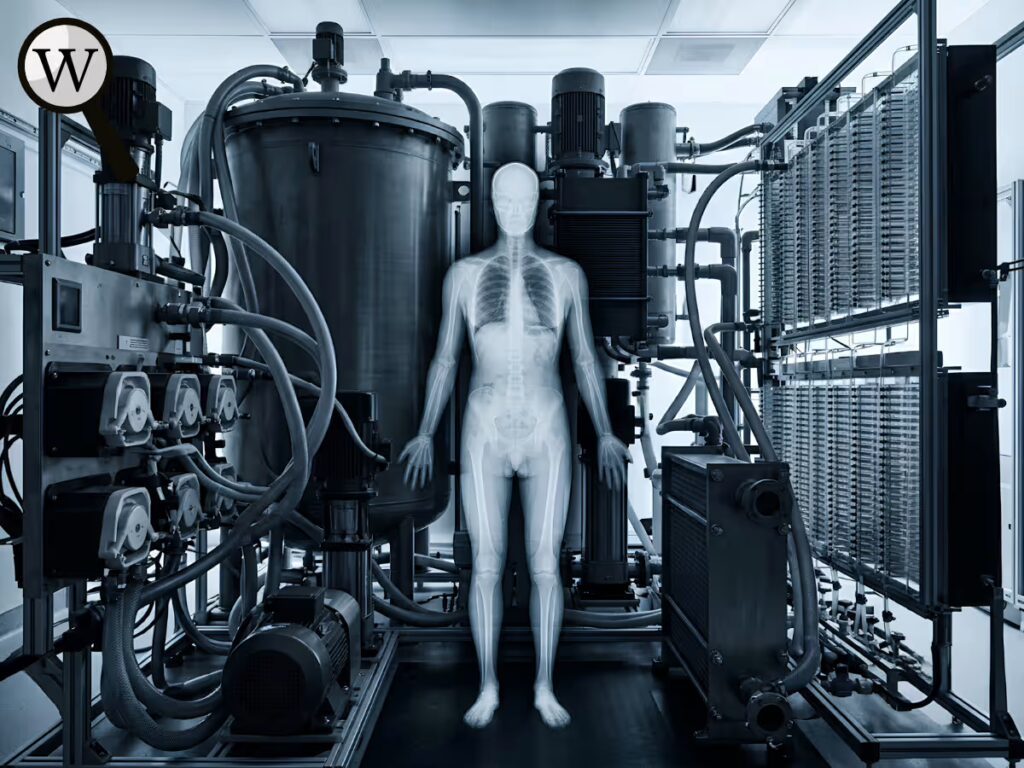
Can We Build a Machine That Fully Mimics the Human Body?
For centuries, humanity has dreamed of creating artificial life. From ancient mythology to modern sci-fi movies, the idea of constructing a fully functional synthetic human—one that eats, digests, filters toxins, thinks, and repairs itself—has fascinated engineers and scientists alike. But if we were to attempt building a machine that fully mimics the human body today, what would it actually take?
While modern robotics and biomedical engineering have made incredible strides in building individual artificial organs, assembling them into a single, cohesive, self-sustaining organism remains one of the greatest technological hurdles in history. When we look closely at the sheer complexity of human biology, we begin to realize that our body is not merely a collection of mechanical parts, but an unmatched masterpiece of design.
In the Holy Quran, Allah Almighty points to this miraculous creation:
وَفِي أَنفُسِكُمْ ۚ أَفَلَا تُبْصِرُونَ
“And in your own selves: will you not then see?”
— [سورة الذاريات: 21] / [Surah Adh-Dhariyat 51:21]
Project Specifications Card
| Target Concept: | The Synthetic Human Machine Hypothesis |
| Course: | Biomedical Engineering, Robotics, & Bio-Philosophy |
| Prep Time (Design): | ~80 Years (Estimated Engineering Roadmap) |
| Build Time: | Indefinite (Full Biological Integration Unresolved) |
| Servings: | 1 Unique Human Blueprint |
The Engineering Blueprint: What It Takes to Replicate Human Biology
To understand why building a synthetic human is so difficult, we must break down the core systems required to sustain human life and evaluate our current technological capabilities.
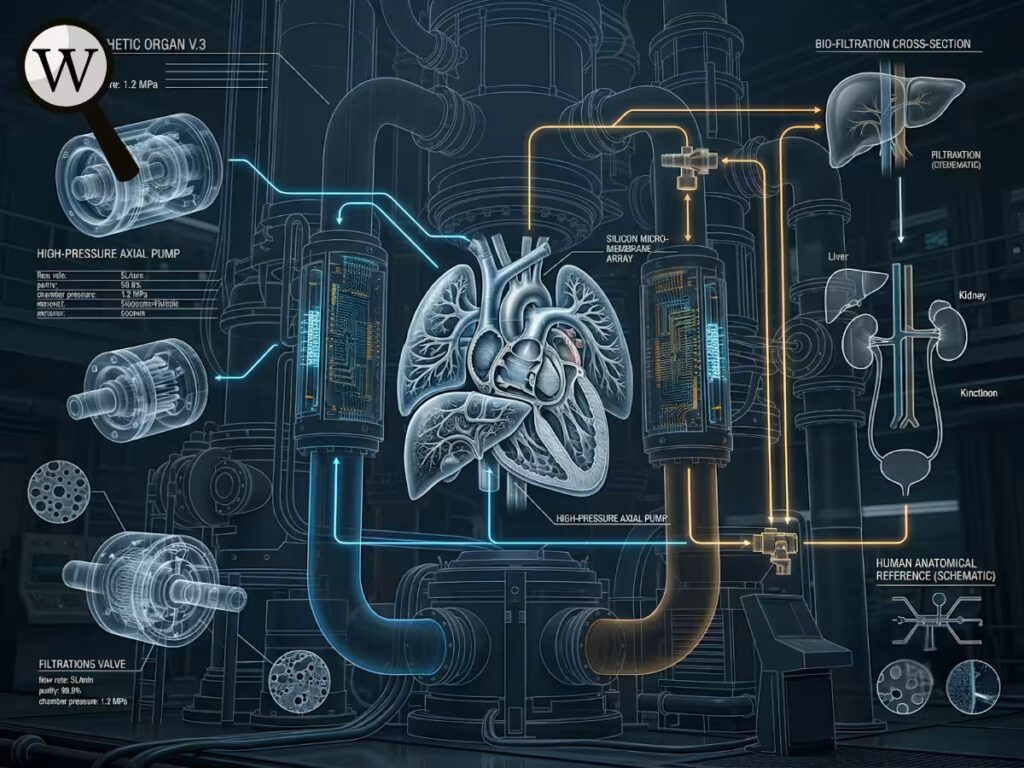
| System | Biological Human Body | Current Synthetic Equivalent |
|---|---|---|
| Framework | Self-healing bones/muscles | Titanium, carbon fiber, EAPs |
| Circulation | Heart (~2.5B beats/lifetime) | Mechanical pumps (HeartMate) |
| Digestion | 500+ chemical liver functions | Lab bioreactors (TIM-1 system) |
| Filtration | Millions of nephrons (Kidneys) | Nanofiltration & dialysis |
| Control & Neural | 86 billion neurons (~20W) | Neuromorphic AI (~Kilowatts) |
1. Structural Framework and Synthetic Muscles
The human skeleton is lightweight, flexible, and capable of self-repair. To replicate it, engineers use titanium frames and carbon fiber. For movement, traditional electric motors are too rigid. Scientists are developing Electroactive Polymers (EAPs)—synthetic muscles that contract when exposed to precise voltage—a modern biomedical application rooted in the fundamental science behind Who Invented Electricity.
2. The Digestion and Chemical Processing Unit
Digesting solid food, extracting glucose, and converting it into pure biological energy requires a miniaturized chemical plant. Modern laboratory simulators, such as the Wyss Institute’s Organs-on-Chips, can mimic gut and liver functions on micro-chips, but scaling these into a compact, internal system remains an immense challenge.
3. Filtration and Waste Management
The human liver alone performs over 500 distinct chemical functions simultaneously. Our kidneys filter roughly 180 liters of blood every day through millions of microscopic nephrons. While wearable and bio-artificial kidneys developed by initiatives like The Kidney Project are currently in development, packed into a human-sized cavity, they struggle to match biological efficiency.
Why Is Assembling a Complete Human-Like Robot So Difficult?
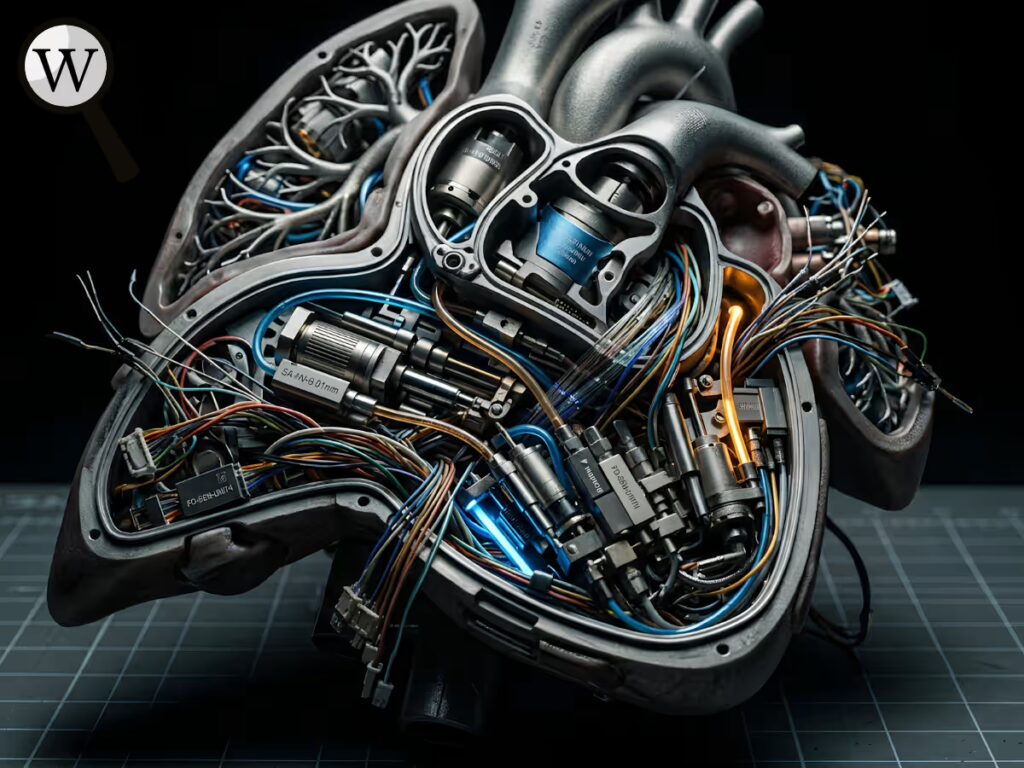
Even if scientists successfully construct artificial hearts, synthetic livers, and robotic limbs independently, connecting them into a single, self-regulating entity presents three massive obstacles:
1. The Interconnected Hormonal Network
In the human body, organs constantly “talk” to one another. The kidneys signal the heart to adjust blood pressure; the gut releases hormones that tell the brain it is full. Much like how the History of the Internet evolved from simple military communications into a complex, global web of real-time data exchange, biological networks handle billions of chemical and electrical signals every second. Replicating this intricate dialogue across dozens of artificial organs requires unprecedented feedback loops.
2. Homeostasis and Self-Repair
If a machine breaks down, it requires external maintenance. Human biology, however, is built with automated repair protocols. DNA continuously repairs itself, skin seals wounds, and bone density adjusts based on physical strain.
God describes this precise stage-by-stage formation in the Quran:
لَقَدْ خَلَقْنَا الْإِنسَانَ فِي أَحْسَنِ تَقْوِيمٍ
“We have certainly created man in the best posture and form.”
— [سورة التين: 4] / [Surah At-Tin 95:4]
Key Challenges in Synthetic Integration
- Energy Efficiency: The human brain operates on approximately 20 watts of power—barely enough to light a dim bulb—while performing calculations that require supercomputers consuming thousands of watts.
- Microbiome Harmony: Human digestion relies on trillions of beneficial bacteria working in harmony with our digestive tract. Recreating this delicate ecosystem inside a machine is extremely complex.
- Scale and Weight: Current prototypes capable of replicating full-body filtration, pumping, and processing would weigh between 300 and 600 kilograms and require the space of an entire room.
The Divine Complexity of Creation
When engineers attempt to reverse-engineer human biology, they quickly realize that every single cell is an information-rich universe. The sheer harmony required to keep a human alive—without us consciously directing our heartbeats or kidney filtration—is a testament to divine wisdom.
الَّذِي خَلَقَكَ فَسَوَّاكَ فَعَدَلَكَ
“Who created you, proportioned you, and balanced you.”
— [سورة الانفطار: 7] / [Surah Al-Infitar 82:7]
While human innovation will continue to produce groundbreaking medical prosthetics, artificial organs, and advanced AI, a fully synthetic human that completely matches our biological efficiency, self-healing capability, and energy balance remains beyond our reach.
Conclusion: The Limits of Human Engineering
Can we build a machine that fully mimics the human body? While we can simulate individual organs using cutting-edge technology, assembling a completely self-sustaining, human-sized synthetic organism is estimated to be at least 50 to 100 years away—if it is possible at all. The journey to build such a machine ultimately serves as a powerful mirror, revealing just how astonishingly complex and perfectly designed the biological human body truly is.
What do you think?
Will humanity ever succeed in building a fully biological-mechanical synthetic human, or will the complexity of natural life always keep it out of reach? Share your thoughts in the comments below!
💡 Fascinated by human innovation and technological breakthroughs?
Explore more deep dives, historical inventions, and future concepts in our Technology & Innovation Section!